
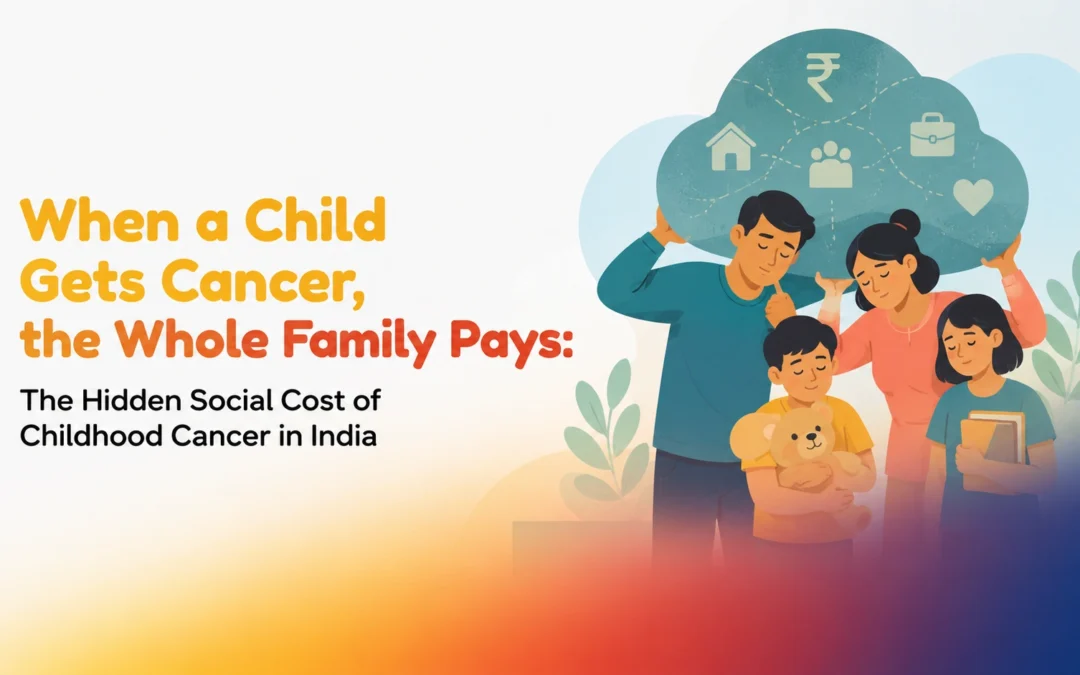
A childhood cancer diagnosis does not happen to one child alone. It enters the entire household.
Suddenly, parents are balancing cancer treatment for children, hospital visits, medicines, travel, work, siblings, school and everyday expenses. For families already living on limited incomes, the impact can extend far beyond the hospital bill. Childhood cancer in India can change where a family lives, how parents work, whether siblings attend school regularly and how connected the family remains to its community.
And that is the hidden social cost we don’t talk about enough.
The Cancer Bill Is Bigger Than the Hospital Bill
When people think about child cancer treatment cost, they usually think about chemotherapy, surgery, medicines and investigations.
But families may also have to pay for transportation, food, accommodation near the hospital and repeated hospital visits. A parent may stop working to become a full-time caregiver. Another may lose income while travelling between their hometown and a cancer centre.
Research among caregivers in New Delhi has documented direct, indirect and psychosocial costs—including lost work hours, travel, food and the strain of managing treatment.
For a low-income family, one medical crisis can quickly become a financial crisis.
What Happens to Siblings?
Imagine being a child whose brother or sister is undergoing pediatric cancer treatment.
Parents may spend weeks or months at hospitals. The healthy child may stay with grandparents or relatives. School routines can change. Attention at home naturally shifts towards the child who is ill.
Nobody is choosing to neglect the sibling. But childhood cancer can quietly reshape the entire family’s emotional and social life.
This is why family support for cancer patients must include siblings—not just the child receiving treatment.
When Parents Have to Choose Between Work and Care
For many families, treatment means one parent becomes a caregiver.
That can mean unpaid leave, fewer working hours or completely leaving a job. If the family has no financial safety net, the consequences can continue even after treatment ends.
A recent Indian study of 1,098 childhood cancer survivors found substantial educational disruption and catastrophic health expenditure among families studied. Relocation for treatment and family job loss were also associated with greater educational disruption.
So affordable cancer treatment is not simply about reducing hospital expenses. It is about protecting a family’s ability to keep functioning.
The Community Often Becomes Part of the Treatment
Cancer care cannot happen inside a hospital alone.
Families need childhood cancer support, accommodation, counselling, nutrition, transportation assistance, school support and compassionate communities. Psychosocial support is increasingly recognised as an essential part of comprehensive pediatric oncology care in India.
A neighbour helping with meals. A school keeping a child’s place open. An employer offering flexibility. A donor supporting treatment. A community refusing to isolate a family.
These may look like small acts.
For a family fighting cancer, they can be enormous.
The Question We Should Be Asking
The real question is not only, “Can we treat this child’s cancer?”
It is also:
“Can we help this child and family survive the treatment journey without losing their education, income, relationships and dignity?”
Because childhood cancer awareness, early diagnosis and access to cancer treatment for underprivileged children are only part of the solution.
The other part is making sure families don’t have to pay the hidden social price of survival alone.
Final Thoughts
A child should never have to fight cancer while their family fights poverty, isolation and uncertainty at the same time.
Supporting a child with cancer means supporting the whole family—financially, emotionally, socially and practically.
Because when we make the journey easier for the family, we make the road to recovery easier for the child.