
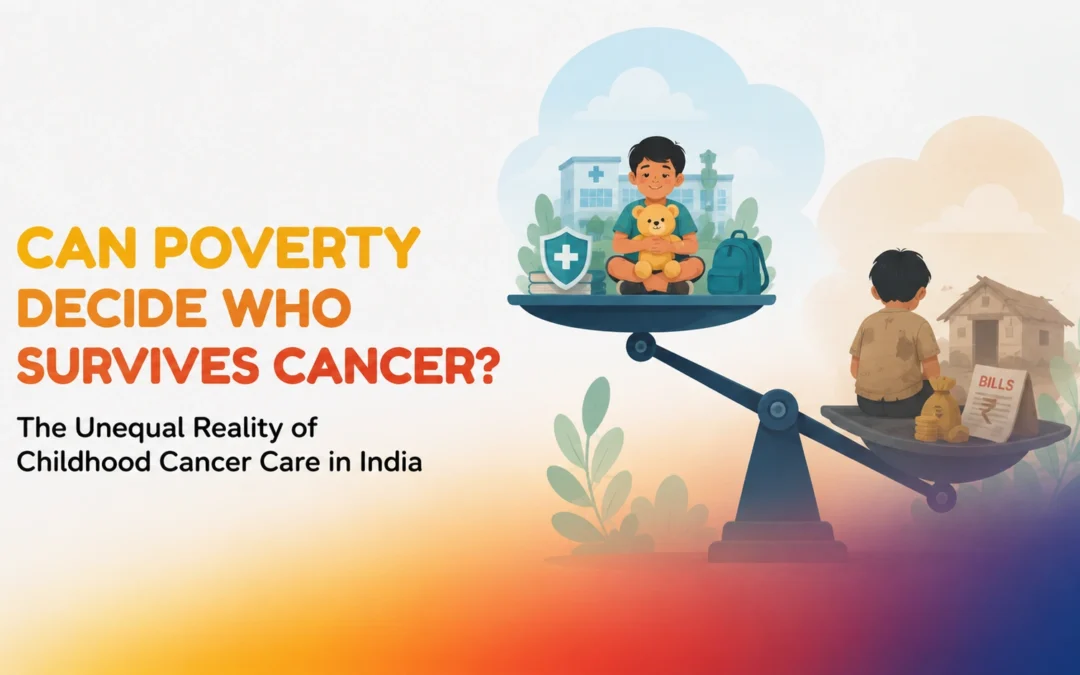
When a child is diagnosed with cancer, parents should be thinking about treatment, recovery and their child’s future. But for many families, another question arrives almost immediately: “Can we afford this?”
In India, childhood cancer care is not experienced equally by every family. Where a child lives, what their parents earn, how far they are from a cancer centre and whether they can afford to stay near a hospital can all influence the treatment journey.
Cancer should be a medical problem.
For too many families, it becomes an economic one too.
The Cost of Cancer Is More Than the Treatment
When we talk about child cancer treatment cost, we often think about chemotherapy, surgery, medicines and investigations.
But families may also have to manage transportation, accommodation, food, repeated hospital visits and lost wages.
For a family travelling hundreds of kilometres for pediatric cancer treatment, every hospital visit can mean another day without income.
And when treatment stretches over months, these costs accumulate.
This is where poverty can quietly become a barrier to cancer treatment for children.
Location Can Matter Too
India has specialised pediatric oncology centres, but they are not equally accessible to every family.
A child living close to a major cancer centre may have easier access to diagnosis, treatment and follow-up.
Another child may live in a rural or remote area where reaching specialised care requires hours of travel—or even temporary relocation.
That distance can affect appointments, continuity of treatment and the family’s ability to remain financially stable.
For parents, “come back next week” can sound very different when the hospital is several hours away.
When Treatment Competes With Survival at Home
For a low-income family, one parent may need to stop working to become the child’s full-time caregiver.
Now imagine losing an income while simultaneously paying for cancer treatment.
Rent still has to be paid.
Food still has to be bought.
Other children still need care.
School fees may still be due.
The financial pressure can become overwhelming.
This is why financial assistance for childhood cancer is not simply charity. It can help families stay connected to essential medical care.
Poverty Can Affect More Than Access
Economic hardship can influence the entire cancer journey – from getting a diagnosis to completing treatment and returning for follow-up.
Families facing financial insecurity may struggle with travel, nutrition, accommodation and long-term rehabilitation.
The problem is therefore bigger than asking whether treatment exists.
We also need to ask:
Can every child realistically reach it, continue it and complete it?
That is the real challenge for childhood cancer care in India.
What Can Make a Difference?
A stronger support system can reduce some of the barriers families face.
This can include:
- Affordable or subsidised pediatric cancer treatment
- Financial assistance for families
- Accommodation near cancer hospitals
- Transportation support
- Nutritional assistance
- Counselling and psychosocial care
- Educational support for children
- Rehabilitation after treatment
- Community-based follow-up
Government programmes, hospitals, NGOs and childhood cancer foundations all have a role to play.
And awareness matters too.
Because sometimes the difference between “treatment is available” and “treatment is accessible” is enormous.
Final Thoughts
Poverty should never become an invisible diagnosis alongside cancer.
When a child needs treatment, families should not have to choose between hospital care and putting food on the table.
The goal should be simple:
The right treatment, at the right time, for every child – regardless of income, location or circumstance.
Because childhood cancer is difficult enough.
A child’s family should not have to fight the healthcare system and poverty at the same time.