
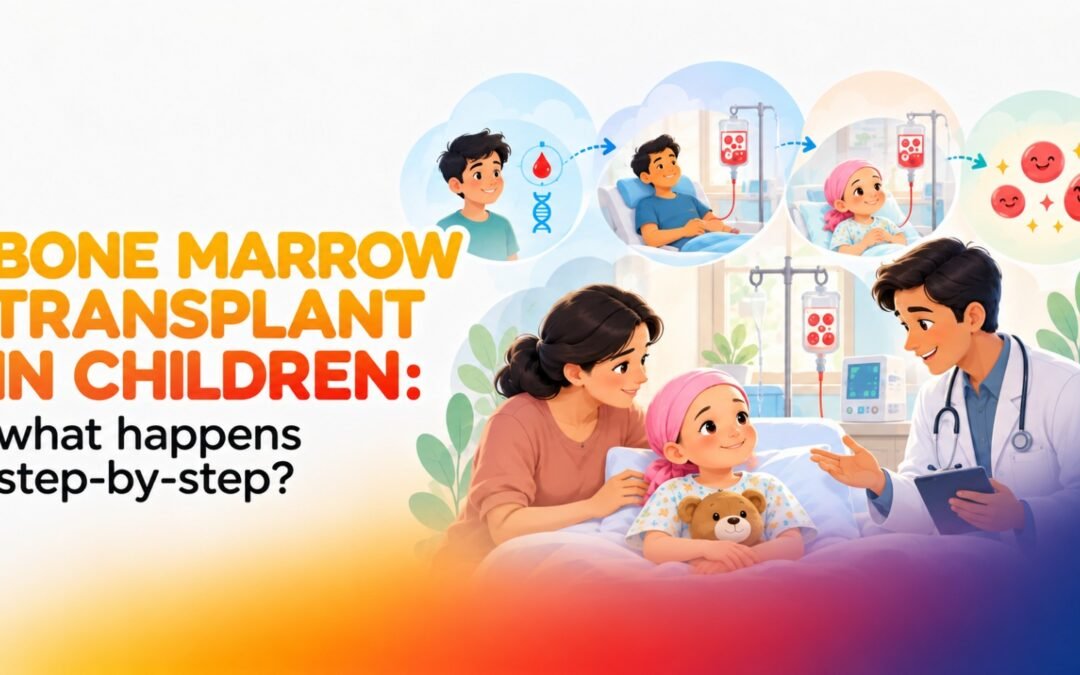
The words “bone marrow transplant” can sound overwhelming to any parent.
What happens next?
Is the donor ready?
Will my child need chemotherapy?
How long will the child stay in hospital?
Understanding the process can make an unfamiliar journey feel a little less confusing. A bone marrow transplant (BMT), also called a hematopoietic stem cell transplant (HSCT), replaces unhealthy or damaged blood-forming stem cells with healthy ones. But the transplant itself is only one part of the journey.
Step 1: Confirming Whether a Transplant Is Needed
Not every child with cancer or a blood disorder needs a bone marrow transplant.
The treating pediatric hematologist-oncologist first evaluates the child’s diagnosis, treatment response, overall health and other medical factors.
The transplant team then determines whether stem cell transplantation may be appropriate.
Step 2: Finding a Suitable Donor
If a transplant is recommended, the next major step is finding a compatible donor.
Doctors may first test siblings because a brother or sister can sometimes be a suitable match.
If a matched sibling is unavailable, doctors may explore other donor options, including matched unrelated donors or other stem-cell sources, depending on the child’s condition and transplant centre.
Step 3: Pre-Transplant Evaluation
Before transplantation, the child undergoes detailed medical evaluation.
This may include:
- Blood tests
- Imaging and other investigations
- Heart and lung assessment
- Infection screening
- Organ-function tests
The purpose is to understand the child’s health before beginning the transplant process.
Step 4: Conditioning Treatment
Before receiving the new stem cells, the child may receive conditioning therapy.
This commonly involves chemotherapy, and in some situations radiation therapy may also be used.
The goal is to prepare the body and bone marrow for the transplant and, depending on the disease and transplant plan, help eliminate abnormal cells and suppress the immune system.
This stage can be physically demanding and requires close monitoring.
Step 5: The Stem Cell Infusion
This is the day many families think of as “the transplant.”
Healthy stem cells are given to the child through an intravenous line, similar to receiving a blood transfusion.
There is usually no surgical procedure to place the new marrow inside the bone.
The transplanted stem cells travel through the bloodstream to the bone marrow, where they can begin producing new blood cells.
Step 6: Waiting for Engraftment
Now comes an important waiting period. The new stem cells need time to settle in the bone marrow and start producing healthy blood cells. This process is called engraftment. During this period, the child’s immune system may be extremely weak. Doctors closely monitor blood counts, infections, bleeding, fever and other possible complications.
Step 7: Recovery and Follow-Up
Leaving the hospital does not necessarily mean the treatment journey is over. The child may need frequent blood tests, medicines, infection precautions, nutritional support and regular follow-up appointments.
The transplant team also monitors for complications such as graft-versus-host disease (GVHD) in children receiving donor stem cells. Recovery can take time, and every child’s journey is different.
A Message for Parents
A bone marrow transplant is not simply one procedure. It is a step-by-step treatment journey involving the child, parents, donor and an entire medical team. There can be difficult days, uncertainty and long hospital stays—but parents do not have to understand everything at once.
Ask questions.
Understand the treatment plan.
Stay connected with your child’s transplant team.
And take the journey one step at a time. At Happy Kids Foundation, supporting children with serious illnesses also means helping families navigate the difficult realities that can come with prolonged medical treatment. Because behind every transplant is a child waiting for a healthier tomorrow.