
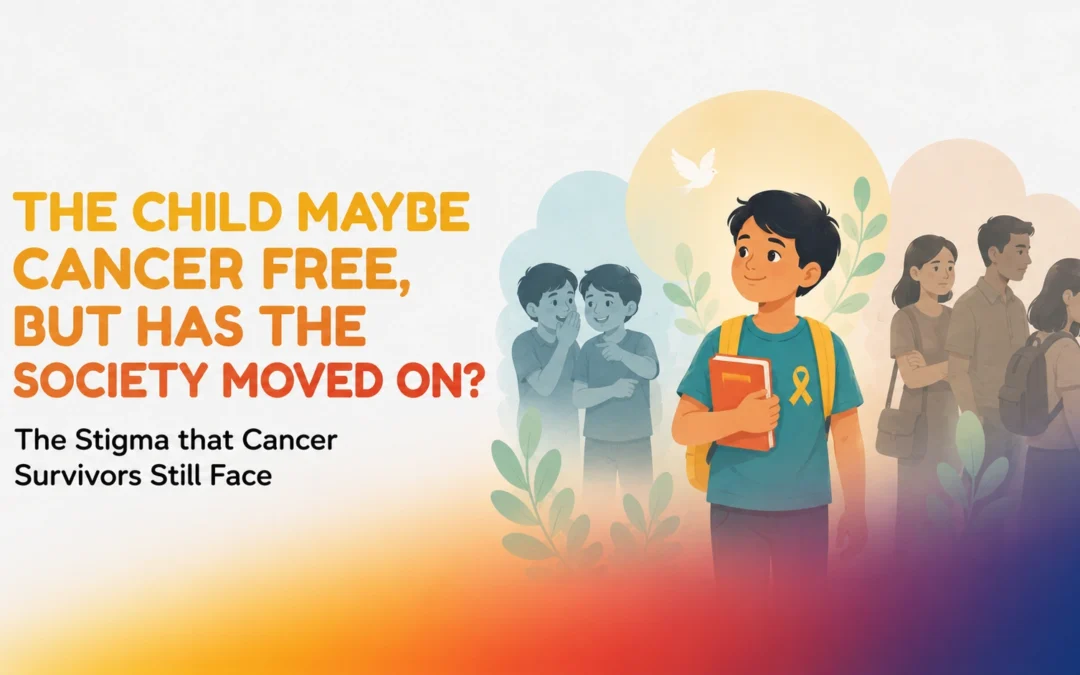
When a child completes cancer treatment, families often hear the words they have been waiting for: “The cancer is gone.”
But recovery does not always end there.
For some childhood cancer survivors, the hospital may become a distant memory while another challenge begins outside it—returning to school, meeting friends, answering questions and proving that they are still the same child.
The cancer may be gone.
But has society moved on?
Cancer-Free Doesn’t Always Mean Life Is Back to Normal
A child who has completed pediatric cancer treatment may still experience fatigue, physical changes, scars, hair loss or other effects of treatment.
And people notice.
Sometimes they stare. Sometimes they ask uncomfortable questions. Sometimes they become overly protective. And sometimes, sadly, they simply keep their distance.
For an adult, these reactions can be difficult.
For a child who is still figuring out who they are, they can affect confidence and self-esteem deeply.
This is the lesser-discussed side of childhood cancer survivorship.
“Will My Friends Treat Me Differently?”
Imagine returning to school after months away.
Your classmates have grown. Their routines have continued. Meanwhile, you have spent months navigating hospitals, medicines and cancer treatment.
You may wonder:
Will they ask about my cancer?
Will they be scared of me?
Will they think I am different?
Will I still fit in?
These concerns can make returning to school after cancer emotionally challenging, even when the child is medically ready.
The answer isn’t to avoid these conversations.
It is to make them easier.
Cancer Is Not Contagious
One important misconception still needs to be addressed: cancer is not contagious.
A child who has had cancer does not pose a cancer risk to classmates simply by sitting beside them, playing with them or sharing a classroom.
Age-appropriate childhood cancer awareness can help children understand this without creating fear or unnecessary separation.
Sometimes, a simple explanation from a teacher can prevent a lot of misunderstanding.
Survivors May Carry Invisible Changes
Not every consequence of cancer is visible.
A child may experience anxiety about recurrence, difficulty adjusting to life after treatment, reduced confidence or fear of being judged.
That is why psychosocial support for childhood cancer survivors is so important.
Recovery should include emotional wellbeing—not just medical follow-up.
Children may need counselling, peer support, rehabilitation and opportunities to rebuild their independence.
Because being declared “cancer-free” is a medical milestone.
Feeling like yourself again is a personal one.
What Can Schools and Communities Do?
A supportive environment does not require extraordinary measures.
Schools can:
- Prepare teachers and classmates before a child’s return
- Provide academic catch-up support
- Encourage inclusion instead of pity
- Address bullying quickly
- Allow flexibility during recovery
- Create a safe space for questions
Communities can do something equally important: stop defining the child by the cancer they survived.
A survivor is not just “the child who had cancer.”
They are a student.
A friend.
A sibling.
A dancer.
A footballer.
An artist.
A dreamer.
Cancer is one chapter of their story—not the entire story.
Final Thoughts
The best way to support a child who has survived cancer is not to constantly remind them of what they went through.
It is to give them the freedom to move forward.
Ask about their hobbies-not only their health.
Celebrate their achievements-not only their survival.
Include them-not out of sympathy, but because they belong.
A child who survives cancer deserves more than a cancer-free report. They deserve a life free from stigma too.